Science & Innovation
The science and innovation behind this project is the driving force which led to its success.
Molecular Simulation
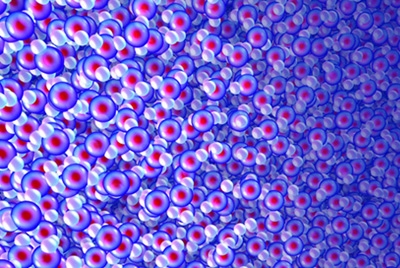
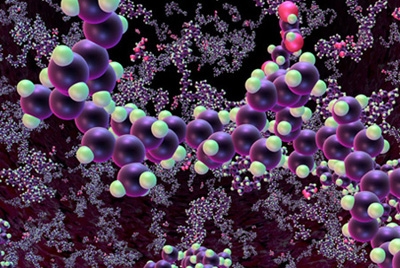
The dynamic nanoscale molecular environments in Riding Snowflakes and Molecules to the MAX! are derived from accurate, state-of-the-art molecular simulations. The location, movement, and trajectory of each atom in these shots were painstakingly simulated by Dr. Shekhar Garde’s team of researchers at Rensselaer. To create believable nanoscale immersion required simulations of massive scale and complexity. Visualizing the plot twists of the story within accurate simulations posed a host of new creative challenges for the collaborators that led to the invention of many creative simulation strategies by the Garde Team.
Data Driven Animation
Translating massive amounts of atomic simulation data onto the giant screen posed unique technical challenges for Nanotoon’s animators. To process and render the millions of atoms in most scenes required the invention of new procedural animation techniques to create the ultra-high resolution frames of Molecules to the MAX! and Riding Snowflakes. Justin Rosen, Nanotoon’s Technical Director, developed custom conversion software within the Autodesk Maya API that allows the massive simulations to be instantly and flexibly visualized. The result is atoms and molecules rendered in cinematic realism, with reflections, refractions, lighting, motion blur, and atmospheric volume. With this new simulation/animation hybrid, the nanoscale universe can now be revealed as never before visualized.
Omnidirectional Projection Systems
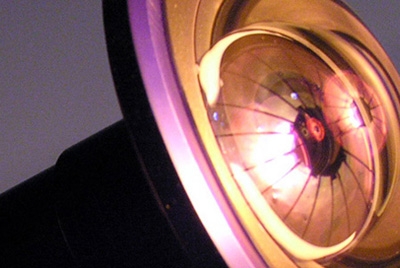
In 2004, when Riding Snowflakes went into production, digital “fulldome” projection systems were in their infancy. The development of single-projector systems with an Omnifocus™ lens radically reduced cost and complexity and created a rapidly growing number of small digital-dome systems worldwide.
Virtual Fisheye Lens
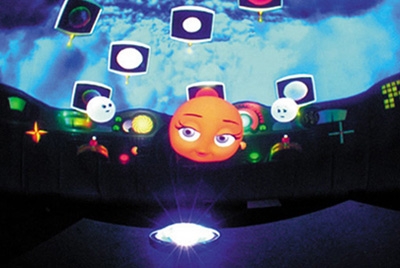
Molecularium – Riding Snowflakes was developed for a digital dome with a single-lens projection system. Inspired by this innovation, the Molecularium team developed its counterpart: an omnidirectional fisheye lens for a virtual camera. The omnidirectional camera captures an entire immersive world in a single frame, streamlining and easing production in the emerging digital-dome medium.
Audio Innovations
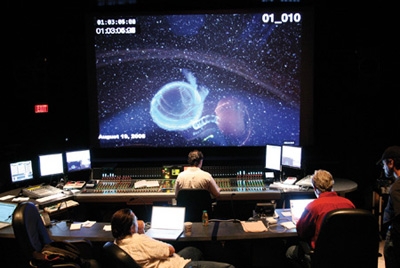
In creating the soundtrack for Molecules to the MAX!, a number of innovations were made in the realm of sound spatialization. As characters and objects fly throughout the immersive CG environment onscreen, their voices and sounds move to corresponding positions in the giant screen (e.g. IMAX) surround sound field.
Sound designer Jesse Stiles collaborated with Lead Technical Director Justin Rosen to create the “Space-o-Matic” system, in which the animation platform Maya automatically passes location information of objects and characters to the sound spatialization system. Using the Space-o-Matic allowed sounds in the film to be automatically spatialized in real time with a high degree of positional accuracy.